Everyone in this category sells stockout prevention, because running out is dramatic and easy to explain. The money is usually at the other end of the shelf. Dead stock is cash you have already spent, sitting where you can see it, and it is the most emotionally difficult inventory problem there is, because clearing it means admitting the purchase was a mistake.
Written August 2026. Proviand's classification thresholds below were checked against the production code at the time of writing.
Whatever you paid is gone. It was gone the day the stock arrived. The only question that matters now is which available option recovers the most cash and shelf space from here, and the price you paid should play no part in answering it.
That sounds obvious written down. It is the single hardest thing to do in practice, and nearly every dead stock decision I have watched go wrong went wrong on exactly that point.
Most tools, Proviand included, need a threshold to draw a line somewhere, and 90 days without a sale is the common one. It is a reasonable default and a bad definition, because it is measured in calendar time rather than in the product's own rhythm.
Set the window relative to how the product actually sells:
A decent rule of thumb: the window should be roughly three times the product's normal gap between sales. If it usually sells every three weeks, nine weeks of silence is meaningful. If it usually sells every four months, it is not.
Proviand flags a product as dead stock when it has units on hand and has gone 90 days with no sale, and separately as overstocked when it holds more than 26 weeks of cover. Both are prompts to look, not verdicts, and the dead stock window is a setting rather than a law. I would rather show you a list you disagree with than quietly bury a slow product because the default said so.
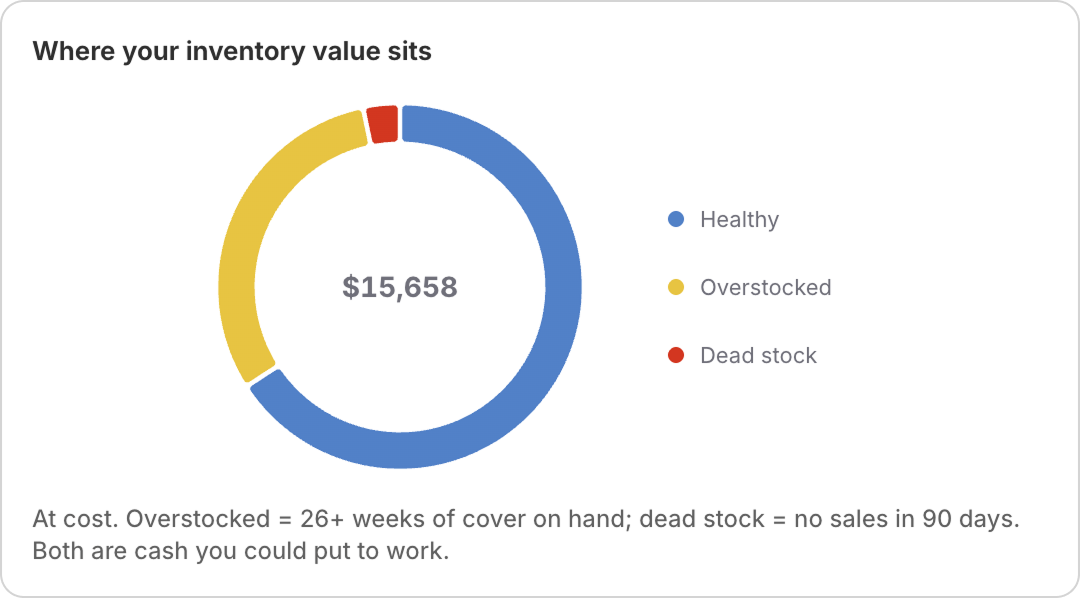
These three look identical in a report and need completely different responses. Getting them confused is how a store ends up discounting its Christmas stock in July.
Seasonal and fine. The product is not selling because it is not its season. Last year it sold 400 units in eleven weeks and nothing for the rest of the year. It is doing precisely what it did last year. The test is whether you have year-over-year history showing the same shape. If you do, this is not dead stock, it is stock waiting, and the only real question is whether you are holding the right quantity for the season ahead. Liquidating it in the off-season means buying it back at full price in three months.
Slow. It sells, just rarely, and it has sold within a window that makes sense for what it is. A slow product with a healthy margin that occupies a shelf nobody is fighting over may be entirely fine. The danger with slow stock is not that it is worthless, it is that you keep reordering it on autopilot. Slow products should be bought rarely and in bulk, not on the same cycle as everything else, which is the ABC conversation.
Actually dead. No sales for well past its own normal cycle, no seasonal pattern in its history to explain it, and no external reason to expect that to change. Discontinued lines, a colourway nobody wanted, the last 40 units of something you stopped promoting two years ago. This is the only category that needs the decision section below.
Before acting on anything in the third bucket, check the boring explanations first. I have seen "dead" products that were unpublished from the online store, lost their images in a theme migration, sat in a collection that got removed from the nav, or were listed at a price with a typo in it. A product that is not selling because nobody can find it is a merchandising bug wearing a dead stock costume, and discounting it will not fix it.
The purchase price is not the cost. It is already spent and it is not coming back in full under any option available to you. Three things are costing you money right now, every week you keep it.
The cash. Money in unsold stock is money not in the products that do sell. If 8,000 of your inventory value is dead and your working products turn over four times a year at a 40% margin, that 8,000 sitting still is roughly 12,800 of margin you did not earn this year. That is the real number, and it is much larger than the discount you are agonising over.
The space and the attention. Shelf space, storage costs if you pay for them, and a share of every stock count, every reconciliation, every time someone has to move it to get to something else. Small per item, relentless, and it never stops.
It distorts your own forecasts. This one is specific to running any kind of demand calculation, and it is worth understanding. Velocity is units divided by days. A product sitting at zero sales drags its own averages toward zero, which is correct and harmless. The damage is at the category level: if you look at average cover or average turns across a catalogue with a long tail of dead products in it, the dead ones flatter the healthy ones or drown them, depending on which way you average. Any inventory number computed across your whole catalogue is only meaningful once the dead stock is excluded or accounted for separately.
Run these in order of cash recovered per week of effort.
1. Return it to the supplier. Always ask first, and ask even when you are sure the answer is no. Suppliers say yes more often than merchants expect, especially for unopened stock, a product they still sell to others, or a customer they want to keep. A restocking fee of 20% is a far better outcome than a 70% discount. This costs one email and it is the option most often skipped.
2. Bundle it. Attach the dead product to something that already sells, as a bonus or a set. This is usually the best of the remaining options because it recovers value without publicly repricing the item, without training your customers to wait for discounts, and it can genuinely raise the average order value of the product doing the pulling. It works best when there is a real reason the two go together. A random pairing reads as what it is.
3. Discount it, once and properly. The common failure is a 10% discount that does nothing, then 20% a month later that does nothing, then 50% four months after that. You have now spent five months of shelf space and cash to arrive at the discount that was going to be necessary anyway, and you have taught your regulars that prices here always fall. If you have decided a product is dead, work out the discount that will genuinely clear it, do it in one move, put an end date on it, and let it go.
4. Write it off. Donate it, recycle it, or dispose of it. This feels like the worst outcome and sometimes it is the best one. If a product will not move at any price you are willing to charge, it is not an asset, it is a liability with a purchase receipt attached. There may be a tax treatment for donated or written-off stock in your jurisdiction, which is a question for your accountant and not for me, but the reason to do it is the shelf and the attention, not the tax.
"I paid 24 each, I am not selling them at 9."
The 24 is gone. It went the moment you bought them and no decision you make today changes it. The actual choice in front of you is between 9 each in cash this month, and 0 each with continued storage costs indefinitely. Framed that way it is not close, and yet the 24 keeps winning, because taking 9 is when the loss stops being theoretical and becomes something you did.
The reframe that works: stop asking "what did I pay?" and start asking "if I had this cash instead of this stock, would I buy it today?" If the answer is no, and for dead stock it always is, then holding it is the same decision as buying it again every single week. You would not do that. You are just not doing it out loud.
Then set a rule while you are calm, before the next batch goes stale, because the decision is much easier in the abstract than with the boxes in front of you. Something like: anything past its dead stock window with no seasonal history gets one recovery attempt, and if that fails it is gone within the quarter.
If you hold very little stock, or you sell made-to-order, or your catalogue turns over completely each season by design, none of this applies and you should not build a process for it. A store with 30 SKUs will spot a dead product by walking past it.
And if you are in the third bucket rarely, that is a sign your buying is working, not a gap in your tooling. Some dead stock is the cost of trying new products, and a catalogue with none at all probably means you are not experimenting enough.
Proviand flags dead and overstocked products against your own history and shows how much of your inventory value is sitting in each, so the conversation starts with a number rather than a feeling.
Staring at a list and not sure what is dead and what is seasonal? Email [email protected] and I will go through it with you.